22/10/2026
In line with its strategy to expand its international research networks, Sabancı University has taken a significant new step toward strengthening scientific collaboration with the University of Edinburgh, one of the world’s most established and prestigious research universities. A workshop themed “Computational, Biological, and Engineering Sciences” brought together academics from both institutions to explore joint research opportunities and discuss the launch of a new seed fund’ initiative.
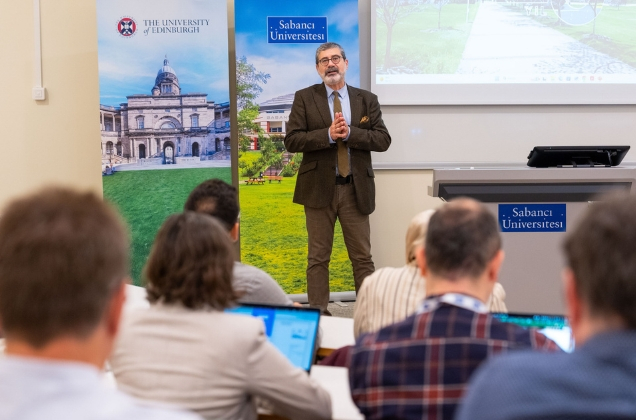
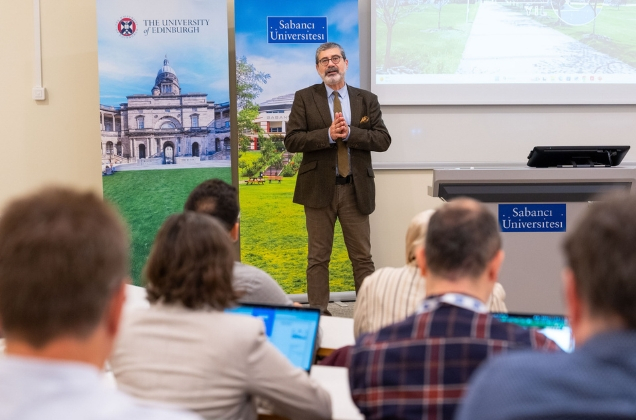
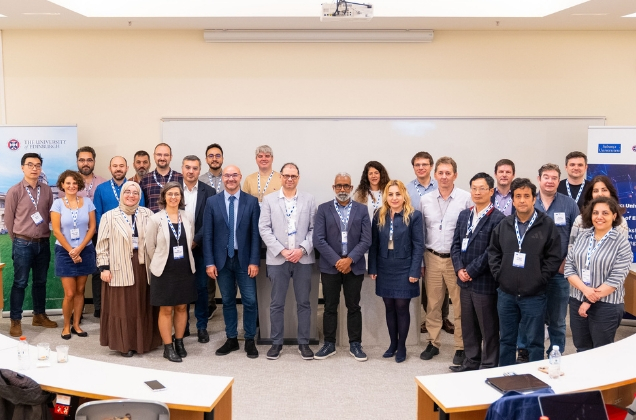
On October 19–20, Sabancı University hosted a joint research workshop with the University of Edinburgh, titled “Joint Workshop on Computational, Biological, and Engineering Sciences.” The event, which featured 10 academics from the University of Edinburgh alongside faculty members from various disciplines at Sabancı University, aimed to bolster academic ties, foster interdisciplinary research, and lay the groundwork for long-term international collaboration.
Throughout the two-day workshop, the participating academics shared their research areas and ongoing projects, while also evaluating potential joint research topics, new collaborative opportunities, and the development of projects for international funding. The program covered a broad spectrum of subjects, ranging from smart communications, data, and autonomous systems to health and life sciences, as well as molecular and materials science, and emerging approaches in computational sciences and engineering.
“We Aim to Pave the Way for More Comprehensive Joint Projects”
The opening address of the workshop was delivered by Yusuf Leblebici, President of Sabancı University. He emphasized that the meeting, which brought together academics from the University of Edinburgh and faculty members from Sabancı University, offered a significant opportunity to develop new research partnerships between the two institutions.
Pointing out that, despite being a relatively young and small-scale institution, Sabancı University possesses strong academic competence across many research fields, Prof. Dr. Yusuf Leblebici stated that the university aims to further advance these strengths through international collaborations.
President Yusuf Leblebici noted that, over the past two years, intensive efforts have been made to cultivate relationships with leading universities across Europe and Asia. He highlighted that a similar initiative with Imperial College London had yielded successful results, leading to the implementation of various joint research projects. He remarked that the workshop with the University of Edinburgh is a continuation of this approach, noting that the complementary research capabilities of the two universities provide a solid foundation for new partnerships.
President Yusuf Leblebici underscored that the primary objective of the event was not merely to share existing research, but to identify concrete areas for collaboration and pave the way for more extensive joint projects in the future. Concluding his remarks by thanking the participants, Leblebici expressed his hope that the workshop would lead to productive discussions and enduring collaborations.
A Model for Generating Resources for Joint Projects Under Consideration
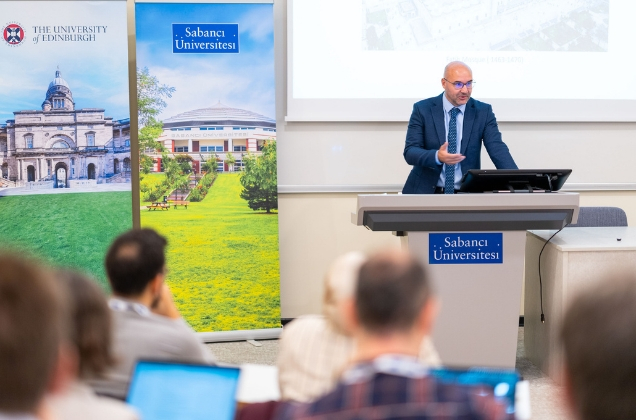
Following the opening remarks, Emre Erdem, Dean of the Faculty of Engineering and Natural Sciences at Sabancı University, presented an approach and a potential implementation model for establishing a joint seed fund for research between the two universities.
In his presentation, Prof. Dr. Emre Erdem outlined the primary objectives of the seed fund initiative: fostering new connections among researchers at both institutions, strengthening existing collaborations, encouraging the participation of doctoral and master’s students in joint research, and transforming early-stage research activities into more extensive international projects. Producing joint scientific outputs and developing robust project proposals to secure external funding were also highlighted as key priorities of the initiative.
Dean Emre Erdem pointed to the potential of this model by citing the seed fund program currently in place between Sabancı University and Imperial College London. Noting that this collaboration has supported eight joint research projects, he suggested that this approach, which brings together researchers from diverse disciplines, could serve as a guiding framework for a potential program with the University of Edinburgh.
The model under consideration with the University of Edinburgh is envisioned to include two types of support tailored to different needs. The first approach is designed to help researchers get to know one another, initiate joint research activities, facilitate the mobility of students and researchers, and build long-term academic relationships. The second approach, operating within a more strategic framework, aims to lay the groundwork for broader activities, such as developing joint project proposals, participating in international research consortia, and fostering industry collaborations.
A Scientific Gathering Across Four Thematic Sessions
The academic program of the workshop, held at Sabancı University, was structured around four thematic sessions designed to highlight the research capabilities and complementary areas of expertise of both universities.
The first session, titled "Intelligent Communications, Data, and Autonomous Systems," focused on research concerning smart communication technologies, data-driven approaches, and autonomous systems. The session on "Engineering for Health and Living Systems" explored research conducted at the intersection of healthcare, biological systems, and engineering.
The session on "Molecular, Materials, and Data-Driven Discovery" featured presentations on molecular research, materials science, and data-based scientific discovery. The final session, "Computational and Engineering Frontiers," examined emerging research approaches within the fields of computational methods and engineering.
On the second day of the program, discussions among the researchers continued through a series of round-table meetings. Participants also had the opportunity to visit the Sabancı University Nanotechnology Research and Application Center (SUNUM) and the Faculty of Engineering and Natural Sciences, gaining a closer look at the university’s research infrastructure and academic activities.